Domain shift has long been one of the key challenges hindering the reliable deployment of artificial intelligence models from laboratories to real-world scenarios. In applications such as autonomous driving, remote sensing recognition, medical analysis, and seismic detection, training data and real-world application data are often collected from different devices, environments, or sampling conditions. Such differences in data distributions can directly affect a model’s generalization ability and deployment reliability.
Although models may perform well on labeled source-domain data, their performance often drops significantly when transferred to new, unlabeled target-domain data. Improving cross-domain generalization in the absence of target-domain annotations remains an important research problem in unsupervised domain adaptation.
Recently, Professor Jianwei Ma’s research team made an innovative breakthrough in fundamental AI research, focusing on theoretical modeling, interpretability, and computational efficiency in unsupervised domain adaptation. The team proposed the Feature-Space Planes Searcher (FPS), a decision-plane search framework in feature space. Their paper, entitled Feature-Space Planes Searcher: A Universal Domain Adaptation Framework for Interpretability and Computational Efficiency has been published as a full-length article, totaling 18 pages, in IEEE Transactions on Pattern Analysis and Machine Intelligence (TPAMI), a leading international journal in artificial intelligence.
The School of Mathematics at Harbin Institute of Technology is the first affiliation of the paper. Ph.D. student Zhitong Cheng and Associate Research Professor Yiran Jiang from the School of Mathematics are co-first authors. Professor Jianwei Ma is the corresponding author. Ph.D. students Yulong Ge and Yufeng Li, master’s student Zhongheng Qin, and Associate Professor Rongzhi Lin also contributed to the work.
Traditional unsupervised domain adaptation methods mostly aim to reduce the discrepancy between the source and target domains by adjusting deep feature representations. However, this process usually requires updating a large number of parameters, which leads to substantial computational overhead when applied to large-scale pretrained models. It also makes the adaptation process more difficult to interpret and control.
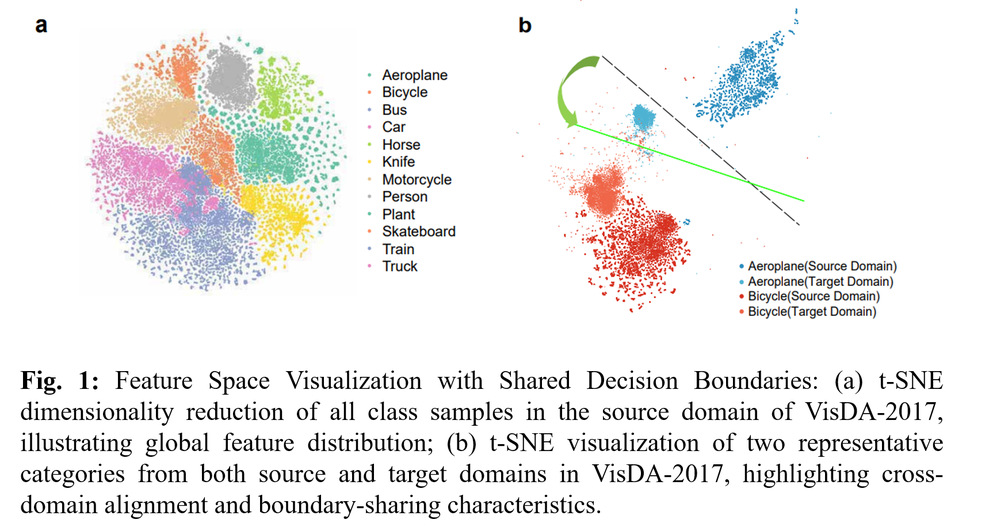
FPS offers a new perspective for fundamental research. When a pretrained model has already formed a stable feature-space structure, domain adaptation can be reformulated as a decision-boundary optimization problem in a fixed feature space. In other words, the adaptation process can be understood as searching, based on the parameters of a pretrained model, for decision planes that best match the distributional patterns of the target domain.
The key idea is not to force the model to reshape the feature space, but rather to identify structural priors and geometric patterns that already exist in the target-domain data but have not been explicitly revealed by labels. For example, samples from the same class are expected to be more compact in feature space, samples from different classes should remain relatively separated, and decision boundaries should avoid passing through high-density data regions. These priors, derived from the intrinsic structure of the data, form the foundation of the boundary search in FPS.
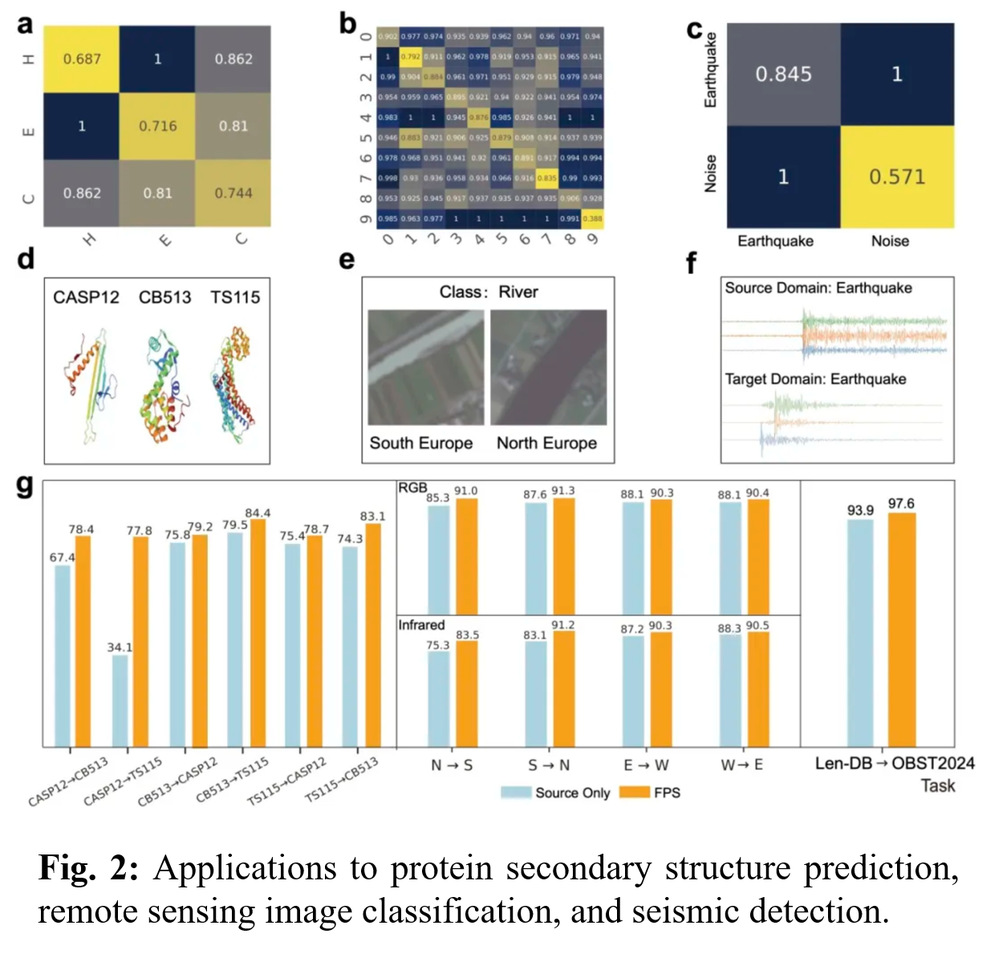
Experiments under this framework show that domain adaptation does not necessarily have to rely on complex and computationally expensive feature alignment. By adjusting only the decision boundary, efficient, stable, and interpretable cross-domain transfer can also be achieved. This work provides a new theoretical perspective and methodological framework for fundamental research in domain adaptation.
The proposed framework can be applied not only to natural image analysis, but also to tasks such as protein secondary structure prediction, remote sensing image classification, and seismic detection. It also offers a promising research pathway for the low-cost deployment and reliable application of large AI models in complex real-world scenarios.